Tuesday, October 16, 2018

On the best evaluation I received during my medicine clerkship.

“Sick or not sick?”

This is one of the many phrases that I learned quickly during my third year of medical school. Hospital teams use it as a shorthand to decide who to round on first in the morning, who needs immediate attention, which patient gets the first echocardiogram of the morning.

Of course, most patients in the hospital are sick by definition, but most of them look not sick. It’s not a perfect shorthand, as any connoisseur of television medical dramas knows because patients can be conversational one minute and coding the next. But the visibly sick patient, especially the patient appeared who appeared not sick upon admission - that patient demands another physical exam, an additional set of labs, a new CT scan. That patient is the one that can easily spiral. That patient may not make it till tomorrow.

I met Mr. J on my first day on the general medicine team at a hospital I had never worked at before. His wife of 32 years had brought him in because of an acute change in his mental status. At baseline (another colloquial phrase meaning what the patient was like before entering the hospital), he was conversational but bedbound due to a previous stroke. When I met him, he was lethargic and confused. He had difficulty speaking and answering our many questions. However, looking at him, he was not sick - which isn’t to say we weren’t working him up - he’d already received an ECG, head CT and was awaiting an MRI. We suspected a new stroke and therefore seemed to have time to find the correct diagnosis and figure out how best to treat him.

Five o’clock came soon enough and I had dinner plans with my classmates so I was eager to leave the hospital for the evening. Before leaving, I went to “set eyes” once more on my patients - another piece of lingo meaning actually looking at the patient and not just their chart. With the demands of the electronic medical record, reading up on our patients, placing orders, following up on consults and studying for the next board exam, actually leaving the resident workroom proves challenging. Interacting with our patients can unfortunately feel like we are getting behind in the day’s work. Horrible, isn’t it?

We have to remind ourselves that face-to-face time with the patient is our most important task. "Setting eyes" is indeed the only way to determine "sick or not sick." Despite the technology at our fingertips, all our white coats are stuffed with folded pieces of printer paper with each patient’s name on it and tiny checkboxes next to the day’s tasks including "consult psychiatry, meet with social work, order TSH, etc." I’ve taken to writing at the beginning of the day, every day:

# See patient pre-rounds.
# Call family after rounds.
# Set eyes late pm.

This helps me avoid the temptation, even subconsciously, to think that time spent with the patient is not time well spent.  Non-negotiable to-do's are without a doubt time well spent. My readers in the medical profession likely know this feeling. Other readers may be appalled. I ask your sympathy for the residents and medical students running hospitals - we are tired, overworked and we are doing our best. In the months that I have been on the wards, I have already seen incredible, behind-the-scenes advocacy for patients from the workroom, while the patients are probably wondering, “Where the heck are the freaking doctors all day?” Hannah Roth, a favorite resident among the medical students, physically ran a urine sample to the lab across the hospital so that a patient who wasn’t even hers wouldn’t have a delay in their procedure. The patient and their family never knew it happened. It won’t be documented in the EMR but that’s the kind of thing that happens every day, quietly and without recognition. It's the kind of small heroism that no one ever sets eyes on.

That evening when I set eyes on Mr. J, I knew he had become sick. His heart raced and his stomach heaved up and down with every breath. Most strikingly, he looked frightened. The facial expression of a nonverbal patient hyperventilating is what I imagine a drowning person to look like. His wife look at me with desperation. I did the first, and it turns out, incorrect thing I could think of, which was to ask his nurse to administer his daily inhaled steroid for his chronic COPD. Even if he was having an exacerbation of his chronic shortness of breath, a maintenance inhaler would not improve an acute exacerbation. Realizing that I was out of my depth, I assured his wife that I would be right back, walked slowly out the door and then proceeded to run to the resident room. Punching the door code, I alarmed my residents saying, “Uhh, can you come help me? Now.”

My instincts were right. Mr. J was very sick. Despite a normal ECG on admission, he was found have acute heart failure, was transferred to the ICU and intubated. I was late to dinner and Mr. J was no longer my patient.

After general medicine rounds the next morning, I went down to the the ICU to find his wife. I found her sitting alone, Mr. J having gone to another test. I let her know that we were all sorry that her husband had experienced such an abrupt decline and that, reflecting on our actions in the previous day, truthfully there was not anything we should have done differently. I told her that we looked forward to Mr. J being transferred back to our team on the general medicine floors once he recovered. I told her this despite my doubts that that would ever happen. Three months into the wards and I already brace myself for the worst. I checked off the box on my to-do list next to “f/u with patient’s wife.”

To everyone’s surprise, Mr. J recovered in the ICU and returned to our team two weeks later. When I entered his room the morning of his return, he blurted out, “How do I know you?” I told him I was part of the team that admitted him to the hospital. He said, “Well, I don’t know about that, but you smell great!” As the days went on, he became more lucid and every morning greeted me with a cheerful “There she is!” I accompanied him to his surgical procedures and held his “Best Dad Ever” baseball cap for him while the surgeons worked. We enjoyed our mid-morning “spa time” when I lotioned his legs and feet with the hospital-grade aloe - his skin fragile and thin after years of immobility and weeks in the dry hospital air. Soon he could follow a conversation and tell me his favorite color was orange and that his favorite dessert was chicken pot pie, which he still insisted should be considered a dessert because “It’s a pie, ain’t it?” By my last day of the rotation, he was ready for discharge to a rehab facility. One only had to set eyes on him to see that he was sick, but not sick.

There’s a lot in medicine that we can just never know. Why did Mr. J present to our hospital with confusion and stroke-like symptoms when he actually had acute cardiomyopathy leading to cardiogenic shock? What caused the cardiomyopathy to begin with? Why didn’t his initial ECG reveal the changes his heart was going through? Why, when we performed an echocardiogram two weeks later, had his heart miraculously fully regained its “ejection fraction,” a measure of how well the heart is pumping? When I asked Mr. J’s cardiologist these questions, he said, “I don’t know. Sometimes these things just happen.”

Other things I don’t know: If I hadn’t set eyes on Mr. J before leaving the hospital that day, would we have lost precious minutes between intubation and pulmonary failure? If I hadn’t gone to talk to his wife that first day in the ICU and he had died, would she have blamed us for not acting sooner, exposing us to litigation and her to emotional suffering? It may very well be that our conversation, something I had added to my to-do list for the day, something that went undocumented in the electronic medical record, was the single best bit of medicine I practiced during my three months on the clerkship.

Indeed, the best evaluation I received for my work on medicine was the bitmoji his wife texted me after his discharge. It said, “I appreciate you!” It was definitely worth being late to dinner for.


Wednesday, November 16, 2016

On the gift of their bodies for the human anatomy course.


On Ash Wednesday in the Catholic Church, a priest smears ashes on our foreheads while repeating, “Remember you are dust and to dust you shall return.” This ominous proverb has to be the biggest crossover between Catholicism and the string theory. It might as well be: “Remember you are carbon and hydrogen, oxygen and nitrogen too, and to these you shall return.” 

I am an emotional person of consistent yet wavering, or consistently wavering, faith in a god. I suspected that the cadaver lab at a highly competitive medical school was the place for an atheist scientist, not someone like me, whose beliefs can be best summarized as “If there is a god, surely she can do whatever she wants, even evolve a universe.” 

Surprisingly though, the knowledge that we are nothing and yet connected to everything steeled me as we took apart a human body piece by piece. I believe that the body is simply a vessel, a vessel we wear around our mortal souls. Or, if ‘souls’ is too parochial for you, a vessel we wear about our intangible essences. Or, if ‘intangible essences’ is too crunchy for you, a vessel we wear to contain the electricity bouncing down our Nodes of Ranvier.

Our cadaver died as a result of metastatic serous carcinoma, an invasive ovarian cancer. Her abdomen was full of scar tissue which had fused her oversized liver to her diaphragm. She was missing her gall bladder, appendix and much of her ascending colon. Her diseased ovaries had been overtaken by tumors. As we frustratingly removed the scarring from her abdomen, it hit me like a wave that hers was not a painless death. How could it have been, with her internal everything maimed and displaced and invaded? It was an obvious thought and yet one I hadn’t had in the previous month of daily dissection. I instantly thought of the glioblastoma brain tumor that killed my beloved godmother. What had the inside of her skull looked like at the end? I was glad I didn’t know. 

But she believed and I believe that the body is simply a vessel and we have seen that the body is complex and flawed and sometimes perfectly Netter and sometimes scarred beyond recognition. 

Our white coats are also a vessel, containing the electricity of our neurons, the intangible essences of our complex personas and our beautiful, ethereal souls, any or all or none of which you may believe in. That’s between you and your god or you and your Darwin. But between you and me, I think that we, flawed specks of dust though we are, are the perfect vessels for the healing work to be done during our blip in the life of the universe. 

May we strive always to be worthy of this gift, the gift to see inside them and inside ourselves.

after 3 months of human anatomy together.


Sunday, October 25, 2015

On Tristan Walker, the first of his generation


I was not part of my sister-in-law’s birth plan and yet there I stood, holding my brother’s baby’s tiny hand as the nurse pricked the heel of his flexed foot to take yet another blood sample. “You are strong, little man,” I said, biting back tears. “You are strong like daddy. You are going to be fine.”

But I don’t know that any of us really could fully believe that. Because our sister, Rachel, wasn’t fine, she was never fine. When she was born, she looked complete and perfect, though small. But her heart never fully formed in the womb and by the time the doctors discovered her unfinished heart two months after her birth, it was too late.

Rachel’s memory was the string, connected and vibrating through my mother, my brother and me in the days after my nephew’s birth: Sometimes babies die, for no reason at all. Sometimes babies die.

“How could this be happening to us again?” we thought. It’s one of those irrational human thoughts, as if enduring one loss means we should be spared anyone else dying for the rest of our lives.

It was not supposed to be like this at all. The baby’s due date fell a week before my spring break in my Pre-Med coursework. I was supposed to arrive in D.C. on Sunday and be presented with my week-old nephew, the first of his generation, and get to snuggle him and with tears in my eyes say, “Well done!” while shaking my brother’s hand.

Instead Tristan’s birth was a week overdue and 51 hours long. Sunday morning, I was on the Orange line platform at Roosevelt headed to catch my flight at Midway when my mother called me to tell me that the baby, only a few hours old, was having trouble breathing. He was being transferred to the special nursery on oxygen and antibiotics. The medical team suspected TTN, transient tachypnea of the newborn, a complication of the long birth involving excess fluid remaining in his lungs, making it difficult for him to breathe. It wasn’t serious, reasonably common, and I needn’t worry. But I come from a long line of overachieving worriers. We go above and beyond when it comes to worry. We are the first to volunteer to worry when we needn’t. If others aren’t worrying enough, as community servants, we will worry on their behalf.

So I worried until I arrived at the hospital and made my way up to the special nursery where I found Tristan in an incubator, wearing a full-face breathing mask with my brother asleep in a recliner next to him. The scene was heartbreakingly sweet, despite the newly arisen medical complications: my baby brother sleeping next to his sleeping baby.

Tristan and his dad.
March 22, 2015

Countless poets and writers have said it more eloquently than I throughout all of time, but I think it bears repeating: love is torture. To love is to have your heart broken again and again by things not going perfectly and painlessly for those that you have the great honor to love. To love is to watch numbers flashing on an oxygen monitor and attempt to will those numbers higher with your mind and a prayer to a God you hope is listening… If you’re being honest, a prayer to a God that you hope exists. To love is to allow yourself to rejoice in the good news that the oxygen levels are stable only to have your heart broken again a day later by the news that the baby, despite being on antibiotics for the TTN, has a fever.

From the way the hospital staff reacted, we could tell it was a very bad sign. My brother refused to leave Tristan’s side in the nursery. His wife, my mother and I slept in the postpartum room, awaiting any news.

A nurse practitioner entered the room and roused us from sleep. Without any lead up or warning whatsoever, she coldly pronounced, “We’ve ruled out everything else, so it’s most likely meningitis. We are going to transfer him to Bethesda to perform a spinal tap and continue treatment.” Now I’ve not been to medical school yet, although I have been accepted to matriculate next fall, but I’ve learned enough from shadowing the Doctors Quinn and House to know that meningitis in infants is a devastating disease and that process of elimination is not the surest path to diagnostic success.

Attempting to remain calm, I said to the doctor, “Can you please explain to her what that means?”

Indignantly she went on, “Well, you can get an infection anywhere in your body and meningitis is an infection in your brain,” which has to be the absolute worst way to explain meningitis to a woman who has been awake for 3 days and spent 51 hours pushing an 8 pound human out of her body.

At that point, my brave, stoic sister-in-law fell apart. My mother held her as she wept and mouthed to me, “Go get Stephen.” I tore down to the hall to where my brother was holding a hysterical Tristan’s hand as the nurse attempted to draw yet another blood sample.

“She needs you,” I said.

“I’m not leaving him here alone,” he replied.

“I’ll stay. You go.” I took Tristan’s hand out of my brother’s and the nurses generously said nothing about breaching the protocol dictating that only wrist-banded parents be alone in the room with the newborn. So that’s how I ended up alone with my nephew who was fighting for his life in the primal, fight-or-flight sense of the phrase. Separated from his mother and surrounded by wires, he was being restrained, starved and attacked from all sides with needle after needle. I had never seen something so small in so much pain.

As I held his hand, I experienced a fascinating combination of fear and love… not for the baby himself, whom I had just met, but for my brother. I felt depths of love for him previously unknown to me. I didn’t know I loved him this much. I feared selfishly how much his loss would pain me. How could I look my brother in the eye if something happened to this baby? What would I ever say to him if his son died? It wasn’t supposed to be like this.

My brother and his wife appeared in the nursery just as the mobile NICU team arrived from Bethesda and began preparing Tristan for transport via ambulance. The doctor leading the transport team approached us and began to explain their plan to my brother.

I gazed down and read the name embroidered on her coat. It read, “Dr. God.” G-O-D. I leaned over to my sister-in-law and whispered, “His doctor’s name is Dr. God…” The doctor could tell we were talking about her and caught my eye. “Yes it is. It’s my married name and, believe it or not, my father-in-law is a Reverend.” Reverend God.

She went on, “In order to take the best care of him, we have to prepare for the worst, in this case, meningitis, but let me assure you, your baby is not in acute distress. He is alert, hungry and really mad, all of which are good signs so we are not in a rush. We’re not going to turn on the siren or the lights. We’re not going to speed and we don’t want you to either.” In fact, she advised us to delay our arrival until after the spinal tap had been performed, a procedure probably too traumatic for a parent to witness. Her optimism and gently commanding demeanor calmed us and everyone stopped needing to choke back tears.

As they wheeled him down the hall towards the ambulance dock, I turned to my mother and said, “Mom, he’s in God’s hands now and God is a woman.”

In Dr. God’s hands, he arrived safely at Bethesda, the spinal tap came back negative for meningitis despite antibodies in his bloodwork, his oxygen levels remained stable for days, and his fever never returned. After 4 days in the NICU, to our relief and disbelief he was sent home. He was fine.

We’ll never know what happened in Tristan’s tiny body and the range of possibility is vast. On one end, maybe it was as simple as a faulty thermometer. Maybe he never had a fever while on the antibiotics in the first place. On the far other side of the spectrum of possibility: maybe there was a miracle and my mother’s hysterical prayers for healing in the hospital chapel were answered as quickly as we could say “Dr. God.”

The truth, of course, is probably somewhere in the middle where science and the divine intertwine. Perhaps the precautionary antibiotics already in his system for the TTN fought off whatever other infection briefly surfaced. Perhaps the little bit of fluid in his lungs saved his life.

We don’t deserve anything and yet we ask for so much. So whenever something doesn’t go my way in the future or a prayer is left unanswered, I hope I remember the one big answered prayer we got in March of 2015 when Tristan Walker, the first of his generation, didn’t have meningitis. I’ll say it again: love is torture and I want to be tortured by my love for that kid for a lifetime. And with God’s grace, I will be, even if God is just an M.D.

Tristan and his dad, wearing noise canceling headphones.
September 2015


Monday, September 28, 2015

Chevron Gradient Afghan


Materials:

  • Size 7, 40 inch circular knitting needles
  • Stitch markers
  • 15 skeins Hikoo Kenzie (160 yards, 50 grams per skein) or 2400 yards of a worsted weight yarn. The colors I used in my blanket are in order: 
1000 - Pavlova
1017 - Kiwano
1007 - Kiwi Fruit
1006 - Kumara
1005 - Bayberry
1011 - Tamarillo
1015 - Boysenberry
1014 - Malbec
1027 - Takahe
1013 - Tekapo
1008 - Kale
1025 - Elegan
1002 - Grey Salt
1018 - Seal
1010 - Glacier

Abbreviations:
  • k - knit
  • p - purl
  • pm - place marker
  • sm - slip marker
  • k2tog - knit two together
  • m1R - make one right leaning increase
  • m1L - make one left leaning increase
  • md - mitered decrease - slip 2 stitches together as if to k2tog, k1, pass the 2 slipped stitches over
  • ssk - slip, slip, knit

Pattern:
Using the first color in your chosen gradient, cast on 237 stitches. 
To adjust the size of the blanket use a multiple of 24 + 1 + twice the # of border stitches on each side.
Example: 237 = (24x9) + 1 + (2x10)

Garter stitch border:

Knit 8 rows.

Chevron Pattern Setup Row:

Row 1 (RS): k10, pm, k1, ssk, k9, m1R, [k1, m1L, k10, md, k10, m1R] repeat between brackets until 23 sts remain, k1, m1L, k9, k2tog, k1, pm, k10
Row 2 (WS): k10, sm, purl to second marker, sm, k10

Chevron Pattern:

Row 3 (RS): k10, sm, k1, ssk, k9, m1R, [k1, m1L, k10, md, k10, m1R] repeat brackets until 23 sts remain, k1, m1L, k9, k2tog, k1, sm, k10
Row 4 (WS): k10, sm, purl to second marker, sm, k10

Repeat rows 3 and 4 throughout body of blanket changing color as you wish. If using Kenzie, work each color until you nearly run out of yarn always ending after a WS row. My sample has 24 rows of each color. That is, for each color, I worked rows 3 and 4 twelve times each to create twelve garter ridges in each color along the horizontal border of the blanket.

Garter finish:
On your final color, work rows 3 and 4 eight times each. Repeat Row 3 once more.
Knit 7 rows ending after a WS row.

Bind off loosely and weave in ends.
Wet block blanket to desired measurements.


Tuesday, September 1, 2015

Clementine Knits Seed Stitch Infinity Scarf Pattern

Luxurious and simple, this scarf is the perfect addition to a winter wardrobe. Seed stitch shows off Madelinetosh A.S.A.P.'s wonderful colorways!

Materials:
  • 3 skeins Madelinetosh A.S.A.P. (shown in whiskey barrel) or approximately 270 yards of a bulky or super bulky weight yarn. I would classify A.S.A.P as a bulky, although on Ravelry it is classified as a super bulky. For reference, it is definitely thinner than Malabrigo Rasta.
  • 24 inch circular size 13 (9mm) needles (straight needles will work fine too!)
Pattern:
Cast on 29 stitches.
Row 1: k1, *p1, k1* repeat to end

Repeat row 1 until nearly all yarn has been knitted, leaving a few yards for bind off and seaming. When joining new skeins know that Madelinetosh A.S.A.P. wet-splices very well leaving you with no ends to weave in!

Bind off all stitches while maintaining the established seed stitch pattern. Using a darning needle, sew ends of the scarf together. Go forth and be warm!


Tuesday, July 21, 2015

DIY Scrabble Themed Party

We decided to host a Scrabble-themed bridal shower for my sweet little sister, Claire. She's always loved playing Scrabble and is notorious for making up "original" words to play. This theme was so fun to play with and created a really unique shower that didn't feel cheesy or sentimental. Surprisingly, when we started looking for ideas online and on Pinterest, there wasn't a whole lot out there. I thought I'd share the ideas we came up with!

The Invitation:

We decided to do only a digital invitation for the bridal shower to be emailed to the guest list. I took a picture of the Scrabble board and "BRIDAL SHOWER" and then added the text over the image in Pages. A couple of screenshots later, I had myself this adorable invite!

The Traditional Bride's Tiara:

Claire absolutely loved wearing this tiara we made by glueing the tiles onto a tiara from Party City.

Decorations & Games:


We had almost 40 people coming to the party so playing any group party games would have been a challenge. Instead, we put out two vintage Scrabble boards, tons of spare tiles that we bought off Etsy and a sign that said, "Play a word that describes Claire." By the end of the party, the board was full of lovely adjectives and nouns about Claire. The centerpiece displaying their future name was handcrafted by our brother, Jeff, as a wedding present. It was a favorite of everyone at the party. Now Claire and Danny have it on the mantle at their new home.

My mom found this great font online to make a Scrabble letter banner. She printed out each letter and mounted it on cardstock. We punched two holes in each letter and used two ribbons to tie each to the toile ribbon.

 We used the tile racks to label lots of things around the party. We had run out of C's by the time we had to label the champagne punch, so we had to settle for the ever classy, "Boozy."

Party Favors:

Mom and I made Scrabble tile charms as the party favors. We started by buying this kit off of Etsy to understand how they are made. Then, in true Clement style, we reengineered them to make them better!

Sweet Treats:


Our neighbor is a very talented baker and she made these bite size cupcakes special for the shower. The tiles say, "Claire and Danny. Love Forever." Aren't they just too cute for W-O-R-D-S? They were such a success and delish. Also Mom found these Scrabble Cheez-Its which were a fun addition to the spread.

The shower was such a success! I can't wait to keep the party going at their wedding in September!


Monday, July 6, 2015

so you're a grown up who wants to go to medical school, part one

Hello wide world out there. It's been a while. So much has happened since my last post... breakups, organic chemistry, new apartments, travel coast-to coast, new roommates, a nephew (who is the best), and the dreaded MCAT (which was the worst).  Woven through it all, the good and the bad, are the thousands of meters* of yarn I've knitted these past two years. I can now say, in glorious past tense that I applied to medical school... the first round of applications anyway.

Getting into an MD program, what was two years ago an unbelievably daunting endeavor now feels close at hand, dare I say, achievable! I thought I would chronicle my journey here for any interested individuals by answering the questions that I had two and a half years ago when I realized I was a grown-up who wanted to go to medical school.

Who are you and why do you want to be a doctor?
I'm Maura. I am 27 years old. I have a BFA in Acting from the University of Minnesota/Guthrie Theater BFA Actor Training Program. I live in Chicago. To pay my rent, I teach knitting and work in a local yarn shop called Nina.

When I moved to Chicago, I was hired as a standardized patient at Northwestern University's Feinberg School of Medicine. Standardized patients are actors who pretend to be sick to train doctors. My favorite part of the mock physical exams with the medical students was the "moment before." When rehearsing a play in acting school, we'd pour over the details of our "moment before." We'd ask ourselves, "What happened right before I, as the character, walked into this room? Where had I just been, who did I see, what did I last eat?" But as a standardized patient, the "moment before" I relished was something different. I loved the anticipation of the moment before the student doctor entered the room. What would that very first moment feel like? What was the essence of the intangible energy that would fill the small, windowless space as soon as another human entered it? Would I feel a sense of calm wash over me or would my flight or flight response be triggered immediately by a brusque misstep? I quickly realized that being a doctor required much more than a wealth of medical knowledge. It was the students I saw who possessed effortless communication skills, a facility for empathy and the courage to look me in the eye and tell me the truth who I knew would one day become someone's beloved doctor. It was in those mock patient rooms that I realized I wanted to achieve my goal of having a challenging career meaningfully serving others, not as an actor, but as a primary care doctor.

What is your goal as a medical practitioner?
My goal is to provide primary care medicine to underserved populations in a unique setting that emphasizes proactive physical and mental health lifestyles. My background in theater, adeptness with communication and human emotion, and passion for healing will make me a powerful force in my patients' lives. Seeing myself running a clinic 15 years down the road, I imagine having monthly walks with my patients, smoking cessation and weight loss support groups and a basket of yarn and knitting needles in the waiting room, as a stress relief suggestion! Some might say I am too idealistic, that the state of medicine is too dismal for anything like that. However, if I am able to successfully execute one tenth of the ideas I have for changing primary care, I will be proud to know that I made my patients' lives better in small, but significant ways.

How did you complete the required pre-requisites to enter medical school?
I enrolled in Northwestern University's Pre-Medicine Post-baccalaureate Program. This is a 2-year night school for career-changers like myself. We attended school two nights a week and all day on Saturdays. Year one was general chemistry and physics; year two was organic chemistry and biology. If you are like me and have to complete all of the pre-med coursework, I would strongly recommend attending a post-bacc program if one is available in your city rather than taking your pre-reqs a la carte. My reason is this:

I couldn't have done it alone.


Nevermind the seven years of attending medical school and residency... getting into medical school is a big time commitment. Attending a post-bacc program to complete the science requirements allowed me to have age appropriate, brave comrades on this journey. My lab partners were other grown-ups with jobs, kids, partners and pasts who were sacrificing emotionally, physically and financially alongside of me to do this. We were each other's cheerleaders, tutors, counselors, knitting buddies and, above all, friends.

When I first began the program, it was hard, it was so hard. Years of yoga, neutral mask and circus skills had turned my brain to artsy fartsy, sensitive mush. Besides the physics and the chemistry just being difficult to master, I went through an additional crisis of faith. After turning down an offer for a play because I was in school, I rapidly spiraled down the ever so helpful “But did I give up my dream??” rabbit hole and I worried that I would grow to regret that leaving acting. A month in, I decided that I was going to leave after the first quarter was over. I confided this to my lab partner, Ciara. She asked me what I was going to do if I left. I said, "I don't know, work in the yarn shop forever?" She looked me square in the face and said, "You can do that when you retire but now you should become a doctor." Months later, I taught Ciara to knit and she is now nearly as obsessed as I am, but she was right. This is my purpose now. That was just one instance where we few, we happy few believed in each other when we didn’t believe in ourselves. As time went on, I pushed away thoughts of quitting … and my brain got stronger like the muscle that it is and the learning came easier and the concepts clearer as more and more lines from Shakespeare were evicted from my brain and replaced with chemical formulas, theories of physical space and organ systems.

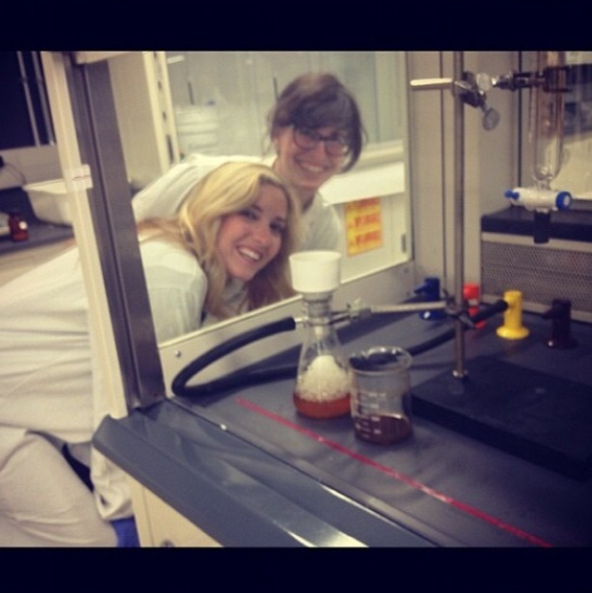
We weren't always smiling as we are in the pictures above, but we did smile and laugh a lot, if only to keep from crying about a low grade or a frustrating assignment. There is talk of pre-meds being ultra competitive saboteurs, ready to cut one another down at the first chance. My experience was anything but that: this determined, diverse group lifted me up, buoying me forward through the hurricane of organic chemistry molecules, endless powerpoint lectures and botched Saturday morning NMR (nuclear magnetic resonance spectroscopy, something I understand, believe it or not). Besides providing wonderful peers, the program provided advisors, a student Pre-Health club, volunteer and job opportunities and a clear trajectory that took a lot of the guesswork out of collecting the pieces of the puzzle required to submit a competitive medical school application.

What was your MCAT experience like?
There is no secret to success on the MCAT. To prepare, I studied 20-30 hours a week for 4 months including a few hours on Christmas Day. I took the Kaplan live online 12-week test prep course. I took 6 practice tests made available through Kaplan. These tests are essential for building stamina and learning how to pace the 60 minutes of each section. However, because the score you ultimately received is a scaled score based on your fellow test-takers' performance, the practice test scores seem to be poor indicators of the score you will receive on test day.  The highest single practice score I received was a 506. The most helpful test was the one released by the AAMC itself. If your prep course does not come with this test, as Kaplan's does, I highly suggest buying it. I took the 2015 MCAT on the first possible test day, April 17, one day before my 27th birthday. In the end, I scored in the 96th percentile and received a 517. I am so grateful to never ever have to take that test again.

That's all for part one! Stay tuned for more in the coming weeks!

xoxo.

*As I'm a scientist now, I use the metric system.

Wednesday, February 19, 2014

"Father Tom to ground control..."


The fall of my junior year of college, I arrived in London to study abroad. I was fully neurotic, perpetually anxious and absolutely no fun at all. Here I was in LONDON and I was supposed to be having the MOST AMAZING EXPERIENCE OF MY YOUNG LIFE. Yet, for almost for no reason at all, I was sad. Really sad, so sad that I wanted to leave, go back to America, get married to my Canadian boyfriend, give up all my dreams and never have to make another decision again.

On a particularly bad day two months into my trip, a day where I almost booked myself a ticket back to the States, I decided instead to go to church. I was raised Catholic and being in a church anywhere in the world still feels like coming home. I’d like to say that I was wandering my neighborhood and out of the London fog rose a steeple and below it, a old wooden door with a round knocker and I found my solace there. But it was 2009 and what really happened was I googled “Catholic Church near me” and walked the .3 miles there. I knocked on the door, which did really have an amazing medieval knocker and a short, gray-haired priest opened the door. I said, choking back tears, “Hi, I’m Maura I’m an American and I’m really sad but I’m Catholic, so I thought I’d just drop by.” I gasped for air. There was a pause. He blinked and then said, “Umm, hello, Moira, why don’t you come in for tea and a biscuit and a chat, because you've just dropped out of heaven and I have not a clue who you are..."

He took me into the rectory and I told him everything, how I started having panic attacks, how I was scared about living here and mad at myself for being scared, and how all my friends just wanted to party, but I felt like it wasn’t real life, I wanted to leave, to leave the acting school I had worked so hard to get into, to drop out, to do something else, to become someone’s wife who wasn’t even asking me to, by the way, someone who wanted me to stay in London, who loved me because I was strong. I finally paused. I had nothing else to say so I took a sip of tea.

He looked up at me and said, ever so gently,
"Moira, you have one million dollars in your hand
and you are about to drop it to reach for a paper clip. 
Don't let your emotions get in the way of reality."

It was the same advice everyone was giving me, and I don’t know, maybe because this time the voice of God was behind it, I was able to step back out of my self-inflicted misery and actually hear it. After that day, I was able to begin the hard work of patching the dam in my mind to hold back the floodgates of my fears. And with time, like everything, it ended, my sadness ended. Study abroad ended. College ended. That relationship ended.

What Father Tom said to me that day is the best advice I have ever gotten. I am prone to get so emotional, so in my own way, that I find it helpful every so often to look into my palms and see, truly see, what it is I am holding before I panic and let it go. Is it a million shiny bucks, or is it a crummy paper clip?

In the end, even though I was a small sad little disaster, I do think I made the most of my time studying abroad, because I got a truly unique, very British experience that the guidebooks don’t tell you about: English Catholic priests brew a really strong cup of truth bomb tea and they are only just a Google search away.

St. Etheldreda's in Holborn, London

This piece, a rework of an older post, was originally performed at Story Club Southside on February 18, 2014.

Monday, January 20, 2014

On what's really unsettling.

A smart, successful female friend of mine recently posted about seeing Spike Jonze's latest film, Her, on Facebook. She said, among other things, that she found it "excruciating and unsettling." Someone whom I do not know commented on this status saying:


I was struck by this remark because I, on the other hand, loved Amy Adams' "retro-futuristic," practical outfits. I thought her unkempt hair was amazing and her skin seemed flawlessly unaltered. Clearly, we disagreed on the matter, perhaps because we have a difference in taste. But the more I thought about his comment, the more it became clear to me that this was not just an issue of mere preference: I like a frumpy, relaxed style and said troll does not, I like curly hair and said troll does not. The issue is in the word "unsettling." This person found Amy Adams' physical appearance in the film unsettling. Let's take a look, if we dare...

Amy (Amy Adams), Charles (Matt Letscher) and Theodore (Joaquin Phoenix) in Her

Amy Adams is 39. She looks her age in this movie. Unsettled yet? She does not wear makeup or straighten her hair.  She dons collared shirts with boxy sweaters over them and carries a leather messenger bag. Her character, also named Amy, incidentally is a video game designer. I don't want to further complicate matters by implying that all ladies who work in tech fields don't wear makeup or dresses either now or in the future. However, as someone who spent ten years acting before enrolling in a Pre-Medicine post-bacc, I can attest that most actresses I know wear makeup most days and many of my science classmates do not wear makeup many days. I don't wear makeup more days that I do wear it now, because my priorities are different and it takes a lot of time to learn the bonding principles of organic chemical compounds... my point is, one should not be unsettled, or surprised even, that a female video game designer in her late thirties presents herself the way that Adams appears in the film.

Perhaps the issue is not how Jonze presented her, but how he didn't present her. He did not present her as a sex object for the viewer's immediate gratification... like David O. Russell did in American Hustle. In this promotional poster, she doesn't look frumpy. She also doesn't particularly look like Amy Adams. She is an airbrushed object, not a woman. Her body is being used to sell this movie to an insatiable consumer. American Hustle's Amy's eyes say she wants you and therefore you are pacified, you feel special, you feel safe, and you definitely don't feel unsettled because then you might walk away and spend your money elsewhere. 

Her's Amy isn't on the poster and she isn't naked in the movie and she doesn't want to have sex with you, thank you very much. We should be celebrating Her's Amy, with all her natural normalness, not tearing her down because she didn't show us any side boob. Glib comments like these are indicative that an actress' most valuable contribution to a film is her physical body. I'm not criticizing Adams for her work as a scantily clad woman in American Hustle. I'm saying it is for her work that she should be valued no matter what she is wearing.

I trust that my friend's friend is a totally reasonable and at least mildly intelligent person. I'm sure if I asked him, "Hey, do you think women should be judged by their looks instead of their character?," he'd say, "No way!" I'm sure if I walked up to him and said, "I'm not wearing makeup or a dress down to my navel, are you feeling unsettled?" he'd say, "No, what are you talking about?" So why did he send this small jibe into the internet ether, even if he was just kidding? He probably didn't realize he was sending it directly into my living room. The hidden and not so hidden judgements in the way we talk about women, especially famous women, twist and distort the way we think about ourselves, i.e., If Amy Adams is unsettling, then I must be vomit-inducing. If women repeatedly hear "harmless" jokes like this one, they quickly become convinced that their value is determined by their ability to visually please others and I don't find that funny.

We can blame the amorphous and omnipresent, big bad Media for the objectification and sexualization of women and for its obsession with youth and desire. We can do that... and let ourselves off the hook. Because today so much media and content is created by us and we must hold ourselves accountable when that content becomes belittling and disrespectful and small. My friend's friend completely missed the point of a movie about reality versus illusion. Instead of saying, "Amy Adams looked unsettling," he could have said "Amy Adams looked remarkably like the normal human being of average means she was supposed to be portraying." Or he could even say, "She looked frumpy." if he absolutely needed to put an adjective on her. Although I still disagree with him, I don't object to "frumpy." Just the other day, I was wearing one of my boyfriend's cardigans with reinforced elbows and a blue patterned dress I made from a vintage sheet I found at the Renegade Craft Fair. He chuckled when I walked into the kitchen and called me "frumpy chic" and I don't think he found me unsettling in the slightest.

I loved Her. I think it is one of the most complete, beautiful portrayals of the simultaneous miracle and tragedy of love in the modern age that I have ever seen. Amy Adams gave a simple and heartfelt performance. And my friend was right, the film was "unsettling" because it forced me to confront my fears of my increasingly digital future self. The message of Her is less about the future and more about today. People would be more comfortable with an Operating System, a partner that can be bought in a vending machine who lacks a physical form and will love them unconditionally, than with a woman who wears clogs and is too busy working on her documentary to worry about what her hair looks like. 

Amy Adams is an actress who is in a movie where she looks like how I look most days and I like that.


Friday, October 4, 2013

On our other sister.


When I was two, my mother had a baby who only lived for eight weeks. My sister Rachel Ann was born with congenital heart defects so complex that none of the doctors heard the irregularities in her tiny valves before it was  too late. Because I was two, I don’t remember anything about her. I don’t remember her being born, I don’t remember her dying, but I do remember her birthday parties. Every July 9th, we celebrated Rachel’s birthday with a special dinner and a birthday cake, but no presents because there was no guest of honor. The six of us sang “Happy Birthday” in the middle of summer to a little person I was told was my baby sister who died because she had a hole in her heart.
Rachel was present on other holidays as well. Each of us has a different color Christmas stocking hand sewn by my mother. Seven in total hang on the mantelpiece: two for my parents, four for the kids and one for Rachel. Hers is made of soft pink corduroy trimmed in ribbon embroidered with baby blue rocking horses. As the years went on, the contents of our stockings matured with us from Lipsmackers, to lipgloss, to lipstick, to liquor. But like the taste of my mother’s spinach quiche, the contents of Rachel’s stocking never changed. Every year on Christmas morning, her stocking was and is filled with a bouquet of pink carnations. It wasn’t until very recently that I realized that because Rachel died in September, my mother must have made the stocking after she died. That’s why Rachel’s stocking has the baby ribbon on it. She knew that this particular pink stocking was for a baby who would never grow up. Until recently, I also didn’t think about my dad ordering those flowers every year for Christmas morning. A strange thing to do, order carnations on December 20th, as they are not exactly your standby holiday fauna.
To this day, when we decorate our Christmas tree each year, the last ornament we hang is a small golden tree with five leaves. One leaf has fallen away from the other leaves, off its branch and rests on the ground. As my mother quietly hangs that tiny golden tree, my father puts his arm around her as if to say, “Merry Christmas. It’s okay to still miss her.” After Rachel died, a number of my parents’ friends who lived on the Naval base in Philadelphia with us planted a tree in her memory. We call it the Rachel tree. We visited her tree and brought balloons to her grave during our yearly visits to the Naval Academy in Annapolis, my parents’ alma mater.
I wonder what rituals like this do to a kid, when ornaments and plants and graves and poorly attended birthday parties are all you can base your experience of someone on. And this is someone you’ve known your whole life, but you can’t remember. I don’t have any memories of my sister. All I have are memories of the ways in which we acknowledged the fact that she existed. I used to think we just did all of this for my mom, that it was something my mom needed because it must have been terrible for her, so terrible to lose something she grew. So terrible to only get two months with someone she held inside her warmth for nine. She must felt cheated and like she had failed and angry at the God which she so, so fervently believes in. I thought we were doing all of this for her because, honestly, I never really got much out of celebrating her birthday or looking at the few photos of her we had around the house or even visiting her grave. I didn’t know her so I didn’t miss her.
But then I went off to college and I missed the Rachel days. Her birthday came and went unnoticed. I haven’t seen her grave in years. She stopped feeling a part of my life.
A few years ago, during my third year of actor training, I had a dream. In the dream, I was in a Michael Chekhov class doing an exercise. I don’t know if you are familiar with Michael Chekhov exercises but they involve imagining a particular set of circumstances as you walk around the room, like imagine the floor is on fire, imagine you are at a cocktail party with the president, imagine your butt is a magnet, that sort of thing.
So in the dream, my acting teacher said, “Okay, walk around the room with your sisters.” And for some reason, dream Maura asked him, “With all our sisters or just the ones that are alive?”
“All your sisters.”
So the picture changed like a flash, because this was a dream, and all the sudden, I was walking around the room, milling and seething, with two other women. One is my younger sister Claire and the other is a woman, about 20 years old, who looks just like me and just like Claire, but different. And the three of us just walked, in silence, weaving in and out of each other, smiling in awareness of each other's presence. Then it was over.
That’s all I remember of the dream. But I swear, I know, it was Rachel. I’m sorry, I don’t believe that my brain could through random firing of neurons and chemical reactions create that vast an experience. I just don’t. I’m not saying it was a ghost or an angel or a vision or proof of the supernatural. I’m just saying it was amazing and eerie and I know it was my sister.
Shortly after the dream, I asked my mom about the decision to make Rachel such a part of the fabric of our lives. Many families experience a miscarriage or the death of a young child and do not discuss it openly or often as we do. She told me something I’ll never forget. She said, "I wanted you all to grow up knowing that bad things happen, for no reason, things you think you can't survive, but you can, you do. We did.” She said something else that struck me during that conversation, about how people sometimes say things like, “Well, you are a stronger person or a better mother because this happened.” She doesn’t think about it that way. Although she probably did grow in unexpected ways by knowing Rachel, my mother knows that the purpose of Rachel’s short life was not to teach her something about herself or the value and unconquerable fragility of life. The purpose of Rachel’s tiny life was to live, for as long as her little, imperfect heart would allow. It’s nothing but vanity to think otherwise.
I never knew how to answer people when they asked me how many siblings I have. To form the words “I’m one of four” has always felt a little wrong in my mouth. Since the dream, when people ask me how my siblings I have, I usually say I am one of five. In the first photograph of the four of us with the Rachel tree, it is a small sapling standing only a few inches taller than my five-year-old brother. We visited the Rachel tree a few years back. In the photo from that visit, the four of us are sitting in the tree a half a dozen or so feet off the ground. It’s funny, in the ornament she’s the fallen leaf, but in the photograph she is holding us all up the way we carried her when she was a baby. In a way, it’s the only picture of all my mother’s children: two girls, two boys and a tree with deep roots into the earth and lush, extending branches reaching towards the heavens.
 
Jeff, Claire, Stephen and Maura in Rachel's tree, 2001

Wednesday, July 3, 2013

On my first summer doing indoor science

"Medicine is my lawful wife and literature is my mistress."
-Anton Chekhov
For the past few years, rehearsing outdoor Shakespeare has marked the official beginning of summer for me. However this summer is different. I have just successfully finished my first semester of what I will call indoor Science or "Maura Does Science" (MDs). I've been glued to my laptop for the past 8 weeks studying Biology and Algebra online at the American Public University as a pre-requisite for the Pre-Med Post Bacc I will begin at Northwestern in the fall. For someone who has spent ten years memorizing Shakespeare, you'd think my first foray into Biology might've been easier. It's definitely going to take some time before my brain wheels start to turn easily over scientific jargon and theories. I can't tell you how excited I was when I caught a line of Shakespeare in my biology textbook: "That is the rub" (see Hamlet's 'To be or not to be' speech). I'm sure that most of my classmates glazed over that phrase without a clue what it meant. I also like to think fondly of the guy or gal who wrote that section while moonlighting as a textbook author while pursuing an MFA in playwriting. 

But something was rotten in the state of the textbook. This photo below was my favorite bit of appalling racism in the textbook:
Subtext: Only straight, rich, white people live in more-developed countries. Those countries also look like Cape Cod or a Gap commercial. They are also much happier than people everywhere else.


Now that my semester is over, I can spend more time crafting with my dear knitting friends and adventuring with my handsome movie star boyfriend (who is currently shooting a big movie I can't say the name of on the internet playing alongside a woman who was in a movie about a big boat that sank because her necklace was so heavy.) I am working on a culinary post I am going to call m2f1 (make two, freeze one) about doubling recipes so I've been cooking a bit more than usual. I just made a stew of Israeli couscous and all of the vegetables in my fridge (small red and yellow peppers, celery, olives, tomatoes and onions). I served it (to myself) with a little bit of Greek yogurt and homemade iced coffee. Delish.

I suppose the biggest lesson from my first semester of MDs was that this endeavor will be very, very challenging. Even people who love science find medical school impossible and  frustrating and tear-inducing. Last week I went up to some girls wearing thick plastic glasses and sideways hats at Filter Coffee who were obviously studying for a med school final and asked them about their experience. They were really friendly and said they hated being med students, but loved people and practicing medicine. As I studied for my Biology final, I felt really comforted by the presence of these hipster doctors. It made me think there's a place for me too. The future of healthcare in this country is in our hands. In my hands. My trembling, passionate, knitter's hands.

I finished knitting the Mara Shawl out of MistiAlpaca Worsted and as I was binding off (finishing, for those of you non-knitters) I found 2 cosmetic, not structural mistakes in the knit 3 purl 2 ribbing on the border of the shawl. I asked the infallible Scot and my wise friend Kirstin whether I should rip out an hour of work to fix the tiny mistakes which no one else would ever notice. Both advised me to leave them as they were. I questioned, "But does that make me lazy because I'm not willing to take the time now to make the shawl perfect forever?" Scot said that maybe for other people it would indicate laziness, but for me it would indicate a release of control, of the need for perfection. Kirstin reminded me of a myth that Amish quilters would leave a purposeful mistake in their exquisite handiwork as a reminder of their own imperfections to keep them humble. And really, the shawl isn't going to ever be perfect. But it is perfectly human, stitch-by-stitch. I left the mistakes in. 


Maura's Mara
So be loving with yourself this summer. Look your mistakes in the face and don't be afraid or ashamed of them. They are uniquely yours. 

HOWEVER, I will say that putting an empty ice cube tray back in the freezer in the middle of summer is not a reminder of your own humility, it's just lazy. xo.